
C-1
1. Stay here. S
2. Don’t go away. S
3.Come back! J
4.Don’t do that. J
5.Don’t go outside. J
6.Don’t worry. S
1. Don’t shout!
2. Don’t go away!
3.Don’t cry!
4. Don’t open the window!
5. Don’t touch it!
6. Don’t laugh!
C-1
1. Stay here. S
2. Don’t go away. S
3.Come back! J
4.Don’t do that. J
5.Don’t go outside. J
6.Don’t worry. S
1. Don’t shout!
2. Don’t go away!
3.Don’t cry!
4. Don’t open the window!
5. Don’t touch it!
6. Don’t laugh!
Mr. Day was a teacher at a school in a big city in the north of England. He
usually went to France or Germany for a few weeks during his summer holidays,
and he spoke French and German quite well.
But one year Mr. Day said to one of his friends, ‘I’m going to have a holiday
in Athens. But I don’t speak Greek, so I’ll go to evening classes and have Greek
lessons for a month before I go.’
He studied very hard for a month, and then his holidays began and he went
to Greece.
When he came back a few weeks later, his friend said to him, ‘Did you have
any trouble with your Greek when you were in Athens, Dick?’
‘No, I didn’t have any trouble with it,’ answered Mr. Day. ‘But the Greeks
did!’
Word outside the 1000: puzzle
What did the Greeks have trouble with?
a. Mr. Day’s Greek.
b. Mr. Day’s friend.
c. Mr. Day’s holiday.
Why did Mr. Day have Greek lessons?
a. Because he liked evening classes.
b. Because he wanted to visit Greece.
c. Because he did not like French and German.
How long did Mr. Day stay in Greece?
a. A month.
b. A few weeks.
c. One year.
Mr. Pearce liked shooting ducks very much. Whenever he had a free day, he
went out shooting with his friends.
But one summer he said to himself, ‘I’ve never been to the mountains. My
holidays are going to begin soon, so I’m going to go to the mountains and shoot
deer. They’re more interesting than ducks, I think.’
So when his holidays began, Mr. Pearce went to the station, bought his ticket
and was soon in the mountains.
He got out at a small station and walked through fields and forests for a few
kilometres. Then he saw a farmer in a field. ‘Good morning,’ Mr. Pearce said to
him. ‘Are there any deer here?’
‘Well,’ answered the farmer slowly, ‘there was one last year, but all the
gentlemen from the town came and shot at it, and it’s gone somewhere else now,
I think.’
Word outside the 1000: deer
Rose left school when she was seventeen years old and went to a college for a
year to learn to type. She passed her examinations quite well and then went to
look for work. She was still living with her parents.
A lot of people were looking for typists at that time, so it was not difficult to
find interesting work. Rose went to several offices, and then chose one of them.
It was near her parents’ house. She thought, ‘I’ll walk there every morning. I
won’t need to go by bus.’
She went to the office again and said to the manager, ‘I want to work here,
but what will you pay me?’
‘We’ll pay you £27 now,’ the manager answered, ‘and £30 after three
months.’
Rose thought for a few seconds before she answered. Then she said, ‘All
right, then I’ll start in three months’ time.’
A. Answer these questions.
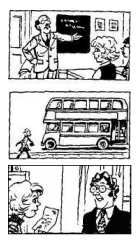
C. Choose the right sentence for each picture. Write it down.

The aim of the project is to enlarge students’ knowledge about other countries’ customs.
The learners find new and strange information about other countries traditions. We read discuss and make a video. We make presentations and put all the materials on our blogs.
This project will be done with 6th graders. The aim of the project is to enlarge our learners knowledge,their vocabulary.
Betty Brown was five years old, and her mother wanted her to begin going to
school, because she wanted to start working in an office again.
A month before the beginning of the school year Mrs. Brown began telling
Betty about school. ‘It’s very nice,’ she said. ‘You’ll play games and paint pictures
and sing songs.’
Mrs. Brown began doing these things with Betty. Betty liked the games and
the painting and the singing very much, but she always wanted to be near her
mother, so Mrs. Brown was rather afraid and thought, ‘What will she do when I
leave her at school?’
But on the first day at school Betty was very good. She did not cry, and she
was happy.
On the second morning Mrs. Brown said, ‘Put your clothes on, Betty. I’m
going to take you to school in half an hour’s time.’
‘School?’ Betty said. ‘But I’ve been to school!’
17
A. Answer these questions.
C. Write this story. Put one of these words in each empty place:
do does doing make makes making
Our children don’t . . . much homework, but they . . . a lot of work in
school. My son George likes . . . furniture and things like that more than . .
. lessons. He sometimes . . . nice chairs out of old boxes in his class. He
and his friends . . . a lot of noise while they are working, of course.
George is good at sport: he . . . the high jump very well. Such sport . . .
children a lot of good, I think. Don’t you?
One morning Mrs. Perry said to her husband, ‘Jack, there’s a meeting of our
ladies’ club at Mrs. Young’s house at lunch time today, and I want to go to it. I’ll
leave you some food for your lunch. Is that all right?’
‘Oh, yes,’ her husband answered, that’s quite all right. What are you going to
leave for my lunch?’
‘This tin of fish,’ Mrs. Perry said. ‘And there are some cold, boiled potatoes
and some beans here, too.’
‘Good,’ Mr. Perry answered. I’ll have a good lunch.’
So Mrs. Perry went to her meeting. All the ladies had lunch at Mrs. Young’s
house, and at three o’clock Mrs. Perry came home.
‘Was your fish nice, Jack?’ she asked.
‘Yes, but my feet are hurting,’ he answered.
‘Why are they hurting?’ Mrs. Perry asked.
‘Well, the words on the tin were, “Open tin and stand in hot water for five
minutes”.’
Word outside the 1000: stand (here meaning ‘put it’)
One day a man went to see his doctor and said to him, ‘I’ve swallowed a horse,
doctor, and I feel very ill.’
The doctor thought for a few seconds and then said, ‘All right, Mr. Lloyd, I’ll
help you. Please lie down on this bed.’
The doctor’s nurse gave the man an injection, the man went to sleep, and the
doctor went out quickly to look for a horse in the town.
After half an hour he found one, borrowed it and took it into his office, so
when Mr. Lloyd woke up, it was there in front of him.
‘Here’s the horse, Mr. Lloyd,’ the doctor said. ‘I’ve taken it out of your
stomach, and it won’t give you any more trouble now.’
At first Mr. Lloyd was happy, but then he looked at the horse again and said,
‘But, doctor, my horse was white, and this one’s brown!’
Dave married, and when his new wife saw the clothes in his cupboard, she said,
‘Dave, you have only got one good shirt. The others arc very old, and they’ve got
holes in them. I’m going to buy you a new one this afternoon.’
Dave liked his old shirts, but he loved his wife too, so he said, ‘All right,
Beryl, but please don’t throw any of the old ones away.’
Dave went to work, and when he came back in the evening, Beryl said to
him, ‘Look, Dave, I’ve bought you a nice shirt. Here it is. Put it on.’
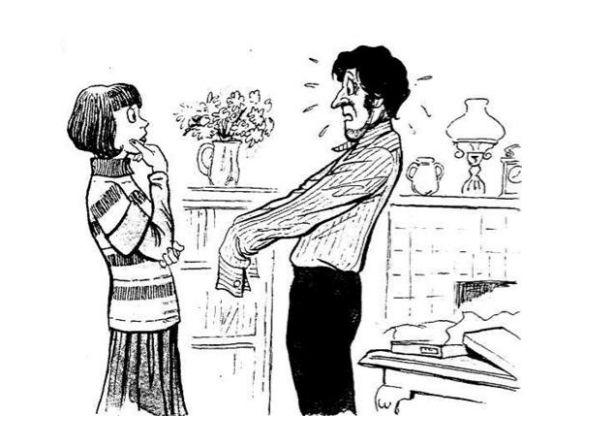
Dave put the shirt on, and then he said, ‘Look at the sleeves, Beryl. They’re
too long.’
‘That’s all right,’ Beryl answered. ‘They’ll get shorter when I wash the shirt.’
Then Dave said, ‘But the neck’s too small.’
‘That’s all right,’ Beryl answered. ‘It’ll get bigger when you wear the shirt,
Dave.’
A. Answer these questions.
What did Beryl say about the collar?
Why did Beryl want to buy Dave a new shirt?
Why didn’t Dave want his wife to throw any of his old shirts away?
Why didn’t Dave like the sleeves of his new shirt?
What did Beryl say about the sleeves?
Why didn’t Dave like the collar of the shirt?
B. Opposites. Write these sentences. Put one word in each empty place.
1.New clothes do not have holes in them, but ….. ones sometimes
do.
Dave loved his old shirts, but he loved his new one.
Sleeves don’t get longer when you wash them. They get shorter.
Good shirts are not cheap. They are expensive
The neck of Dave’s shirt wasn’t too big. It was too long.
C. Choose the right sentence for each picture and write it down.
a. The sleeves are too long,
and the collar is too small.
6
b. The sleeves are too short,
and the collar is too small.
c. The sleeves are too short,
and the collar is too big.
4
d. The sleeves are too long,
and the collar is too big.
1
a. None of these shirts has got holes in it.
1
b. Some of these shirts have got holes in them.
3
c. All of these shirts have got holes in them.
2,3,4,6
 Ագապե Ավագյան